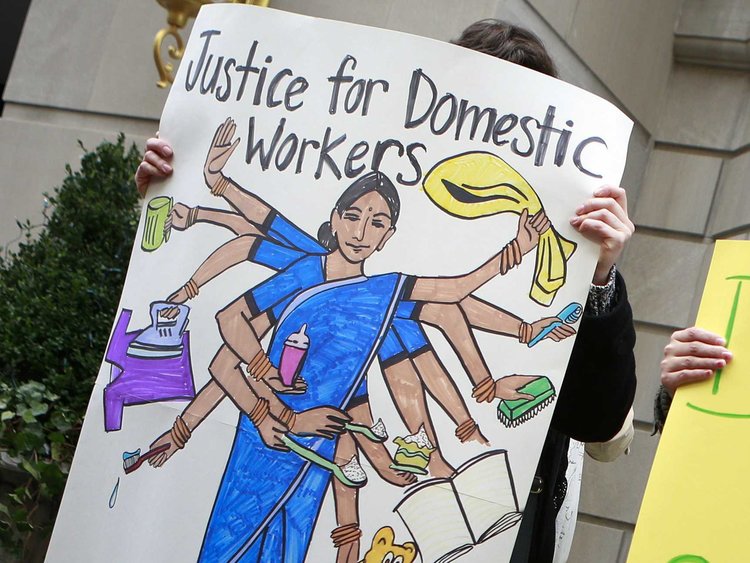
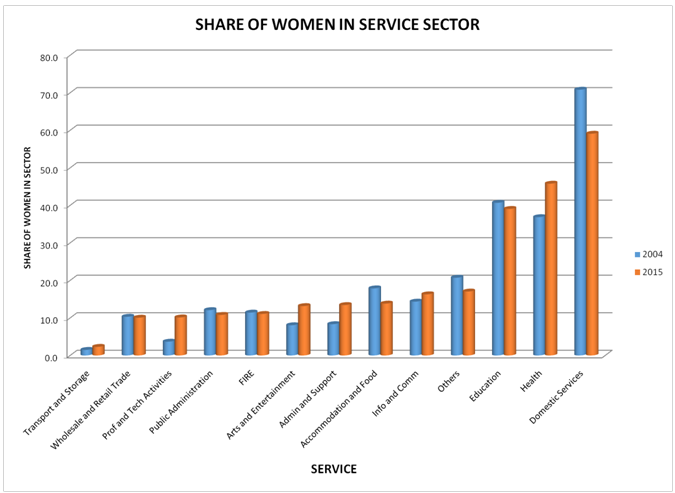
Feminists and especially Marxist feminists state that unpaid care work done by women, the oppression and stereotyping done which results in the women not doing any paid work but staying at home reproducing the labour, in both the biological and social sense where the man is able to go regularly to work because the woman is constantly caring for him. The major solution suggested to this problem is that women also work as wage labour, when this happens, the housework is not shared by the husband and wife but rather another woman is held responsible to do the same job with the same conditions of respect, oppression and degradation with just one minor change in the reward where that woman is paid a substantial wage. There has been an improvement in the female economic participation in India, according to 1991 census female WRP for urban areas was 7.18 which rose to 8.31 in 2001 and finally to 9.91 in 2011. Regardless of the above, the average time spent by a man in India doing housework is only 19 minutes a day while the women spend above five hours according to the Organization for Economic Co-operation and Development (2014).

In India, domestic help is one of the jobs that are part of the informal sector. The informal sector is the part of the labour force in which the labour is unorganized with no regular work, no job security, no health security and risky workplaces. According to the National Commission of Self-employed Women, almost 94% of working women in India work in the informal sector.
Laxmi is the househelp in this house. She is in her early 30’s, she is a mother of 6 children. Her husband does small time daily wage jobs like cleaning people’s cars. She lives in the slum on the other end of the city near the river. She has to walk for 10 mins and wait another 20 minutes to use the public toilet and she gets water twice in a week. Her responsibilities in the Sharma house are to clean the house, do the preparatory (supplementary) work for cooking and to take care of the children of the house. She works in 4 houses, she starts at 9 in the morning and goes back home at 7 in the night every day of the week. She earns 800 rupees per month per house. Even though she is upset that she has 3 daughters, they are the ones who handle the house while she is away. Her eldest son works on a construction site and the other two sons go to school.
She cleans every other place in the house except for the Pooja room because she is not allowed to go there, this is mainly because she is from a lower caste. She is allocated the utility space behind the kitchen where the washing machine is kept and the vessels are washed. She eats and rests in that space when she is done with her work. she has separate vessels allocation. She can only use the common bathroom that is on the terrace of the apartment meant to be used by all the domestic help. She is frowned upon every time she takes the lift.
References:
Kumar, P. (2015). Women in unorganised sector-a case study of maid servants in Ghaziabad city. Journal of Commerce and Trade, 10(1), 66-73.
Basole, A. (2018). State of Working India 2018.Bengaluru: Azim Premji University.
EMPLOYMENT, M. O. Reporton the Fifth Annual Employment – Unemployment Survey (2015 – 1 6 ) Vol. 1.Chandigarh: GOVERNMENT OF INDIA.

 The Average Indian Household