The Indian economy is a vast subject to study and it is impossible to make one understand what constitutes the Indian economy, how it functions and what all aspects fall under the subject who has no prior knowledge of India and its economy. In order to get a sense of the Indian economy, we decided to look at it through a household that is economically a middle class. This household consists of Sanjana Sharma the wife, Rohit Sharma the husband, their son Nihal and daughter Priya. Laxmi the house-help is considered as an external part of the household. The family lives in an apartment located in the suburban part of India.
Family history:
Migration of labor force from rural to the suburbs and urban parts of the country has increased over the years. Rohit had to migrate from a small village in Uttar Pradesh because his parents did not want him to face the economic difficulties that they faced from agriculture. So Rohit migrated and started working in the service sector for better income and economic stability. Both Rohit and Sanjana are from the same village. According to the economic survey of 2018 the agriculture sector in India witnessed employment over 50% of the total labor force but still contributes just 17% to 18% to the GDP[1] of the Indian economy giving a reason to migrate from villages to suburbs and urban areas. Census of India conducted a survey for 1991-2001 and the results are quite shocking as 53.3 million people actually migrated in 2001[2].
Food is essential for human beings to survive. As human kind evolved, food no longer was free of cost; everything had a price tag to it. People as a household now had to allocate a part of their income on food. Budget on food depends on the size of a family. For example, the Sharma family consists of just the father, mother and two children. Here a small part of Sharma’s income goes into budget on food. Budget allocations for non-food items share a very small percentage taking into consideration the life style of a family.
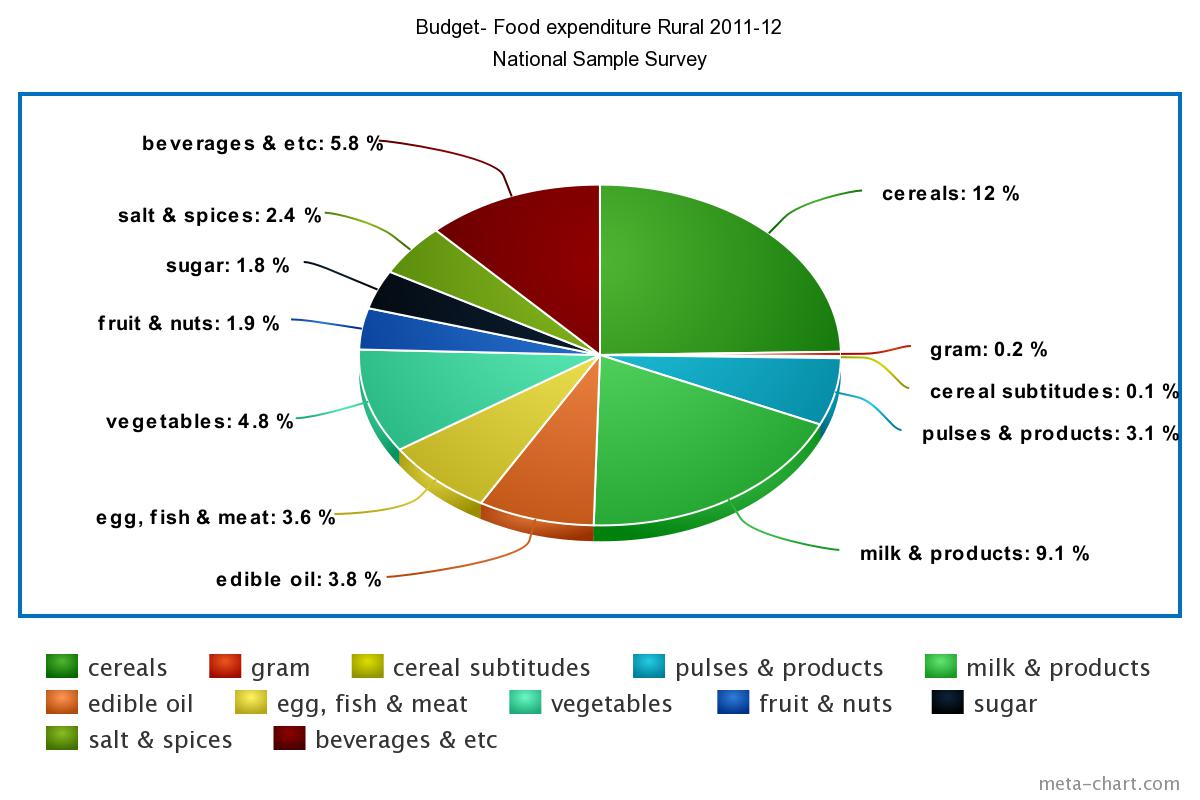
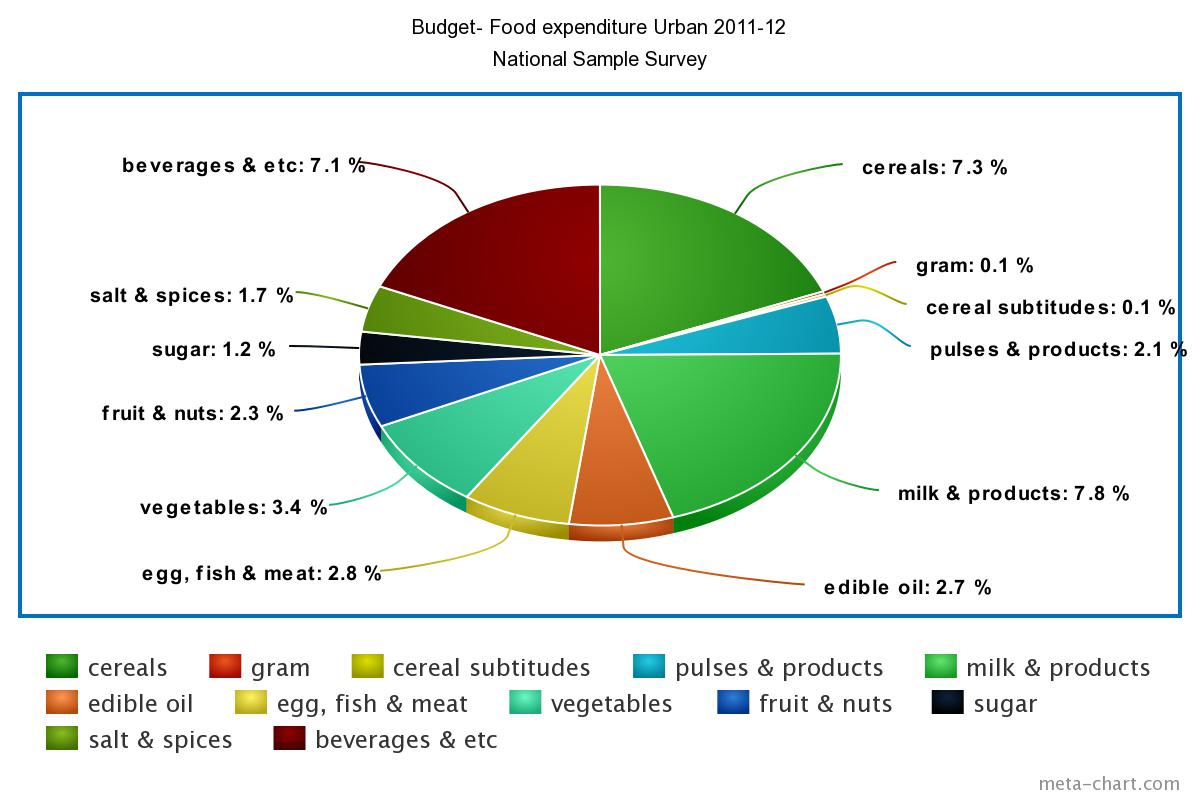
A country as a whole is divided into two geographical sectors; urban and rural. The different education qualification, employments, income and lifestyle of the people in both rural and urban India reflects on the expenditure made on consumption of goods and services that include food and non-food item groups. We are looking at a data produced by the National Sample Survey that surveyed key indicators of household consumer expenditure in India. The data covers surveys from the year 2004, but we are using data for the years 2011-12 considering it to be the latest data.
Food consumption accounted for most of the household expenditure in the survey conducted during 2011-12 of both rural (53% ^) and urban (42.6%) India. On an average, food consumption accounted for the overall budget expenditure of a household in both rural and urban India. According to the reports by NSS, household consumption food was much lesser than that f rural India accounting food items that includes 9% by beverages and processed food, 7% by milk and its products and less than 7% on cereals. The survey also indicates that the expenditure on food also includes the value of home produced food consumption. Processed food plays a major role in the budget of households in urban sector.
Consumption of cereals and milk (its products) is more in rural India mostly because of the agricultural background and self produced. The average household expenditure on food has increased since 2004-05 in both rural and urban India indicating the value of a consolidated income.
But non- food item groups had comparatively higher consumption expenditure in urban India. The data is calculated on the basis of average of the entire estimated population. Rent has taken an increased share in urban India since 2004-05 over 1% with conveyance also having an increase in 1%. Expenditure on education has witnesses an increase in share in both the sectors over the years. Entertainment has played a vital role in consumer expenditure over the years in both sectors resulting in an increase of share to 1%.
Sources: NSS 68th Round, Key Indicators of Household Consumer Expenditure in India, July 2011-June 2012.
According to Marxian theory, classes are defined on the basis of means of production, thus a middle class is said to be the class below the ruling class and above the proletariat.
In an
Indian household, the hierarchy are clearly seen and the ideal of conduct
(among the family members) help maintain the family harmony. It is the eldest
male in the family who is supposed to have the authority and is
responsible for meeting all the needs of the family members. Traditionally,
males are responsible for the key source of income, land and business and other
family resources are usually controlled by the men of house.
In the
household we have chosen, the man is the key earner in the family. His name is
Rohit Sharma. He has migrated from a rural farming background to urban service
sector. He is working in an IT firm. It firm emerged in 1967 in Mumbai as a
Tata group came in partnership with Burroughs. Liberalization had a great
effect on IT sector, leading to annual economic growth of 6% from 1993-2002. In
the contemporary world, India is the largest exporter of IT and it constitutes
79% of the total industrial revenue .US accounts for two third of this sector’s
export. Looking into the data, there is a significant increase in the
contribution of this sector to India’s GDP. It has increased from 1.2% in 1998
to 7.7% in 2017[1].
IT
sector represents the organized sector of the economy. The organized sector
includes workers employed by the government, state own enterprise, and private
sector. In 2008, the organized sector employed 27.5 million workers, of which
17.3 million worked for government.[2]
In the bar graph below, we can see the employment generation of in education, has been the highest in the organized sector(5.2 million).
Source- State of working India
Source- State of working India
In the
given graph , we see that, Sikkim has the highest percentage of worker- 58.2%
working in formal sector, i.e. regularity of workers, benefits given to the
workers and the written contract, Chhattisgarh reports the lowest percentage of
worker in the formal sector 2.3%.
Source- State of working India
In the given graph, we see that the gender wage gap in the organized manufacturing sector is high but has been declining, and the major break down happened from 2013 to 2014.
Through the eyes of the man, we explored the formal sector of the Indian economy validating it with data.
REFFERENCE:
Wikipedia contributors. “Labour in India.” Wikipedia, The Free Encyclopedia. Wikipedia, The free encyclopedia, 8 Nov. 2018. Web. 21 Nov. 2018.
Wikipediacontributors. “Information technology in India.” Wikipedia, The Free Encyclopedia. Wikipedia, The Free Encyclopedia, 10 Nov. 2018. Web.21 Nov. 2018.
Basole, Amit. State of Working India 2018. Azim Premji University. 2018.
Sanjana is the woman of our household who is formally unemployed and engages as a housewife in the household. Her contribution to the reproduction of labour force is unaccounted and excluded from GDP and other indicators of economic development. Sanjana occasionally earns some money by engaging in tailoring services at home. However, this income she earns is not sufficient to support her family and her work is considered as a supplementary income for the household. Not only is Sanjana confined to the household, but she also employs her own domestic labour thereby making the household itself a workspace. There are several reasons as to why Sanjana does not work. India’s employment rates and labour force participation is highly gendered and influenced by factors such as education levels, marital status, caste and class. The Indian economy is also heavily influenced by forces of patriarchy which are embedded at the institutional level through the education system, religion, laws and societal norms.
According to the National Family Health Survey 4, 24 per cent of women age 15-49 are currently employed, compared with 75 per cent of men age 15-49. The case for the urban vs. rural population is also similar although there isn’t much disparity within the same gender.
The gender inequality is, even more, striking between men and women in rural vs. urban areas. While 76% and 75% of urban and rural men, respectively are employed only 21% and 25% of urban and rural women are employed. There are more rural women employed than urban women in the country. The percentage of unemployed women in the 12 months before the survey was also higher among urban women with 75.1% than for rural women with 66.7. This corresponds with the findings of the International Labour Organization report on Care work and care jobs for the future of decent work. It was found that India and Madagascar were the only countries where women’s unpaid care work is found to be more time-consuming in urban than in rural areas. The reason that urban women spend more time engaging in unpaid care activities than rural women could be why there are less employed women in urban than in rural areas.
Women in India spend a majority of their time in providing care activities to the children, elderly and for maintaining the household. As per the ILO report, men perform the lowest share of unpaid care work in Asia and Pacific, with Indian men only spending 31 minutes in unpaid care work which is 7.9% of their working time. At the same time women in India spend up to 297 minutes of their working time in unpaid care work. Moreover, if the value of unpaid care work was taken into the GDP, then men contributed to 0.4% while women contributed 3.1% to the GDP in the form of unpaid care activities in India.
The issue of gender inequality in India cannot be solved by policy reforms alone. In fact, the major reasons for this inequality lie within the society, inside the family. The attitudes towards women working and having economic freedom is still biased. Many women stay back from working due to family pressures and societal norms. Women also experience extreme forms of domestic and physical abuse in households and refusing to listen to their decisions, only increase her exposure to abuse. As per NSFS-4, 33% of ever-married women gave experienced physical, sexual or emotional spousal violence. The most common type of violence is physical violence (30%), followed by emotional violence (14%).
Source: International Institute for Population Sciences (IIPS) and ICF. 2017. National Family Health Survey (NFHS-4), 2015-16: India. Mumbai: IIPS.
The above figure shows the percentage of women and men who agree that a husband is justified in beating his wife for specific reasons. 52% of women agreed that the husband is justified for beating his wife for any of these reasons while 42% of men agreed to the same. For all reasons asked, the percentage of women who agreed were more than men. This is evidence to show that women in India are not only victims of patriarchy but also perpetrators of patriarchy. Women have been conditioned to accept norms, laws and rules which further the interest of men above themselves and believe that it is justified. In fact, very few of them believe that they have another choice.
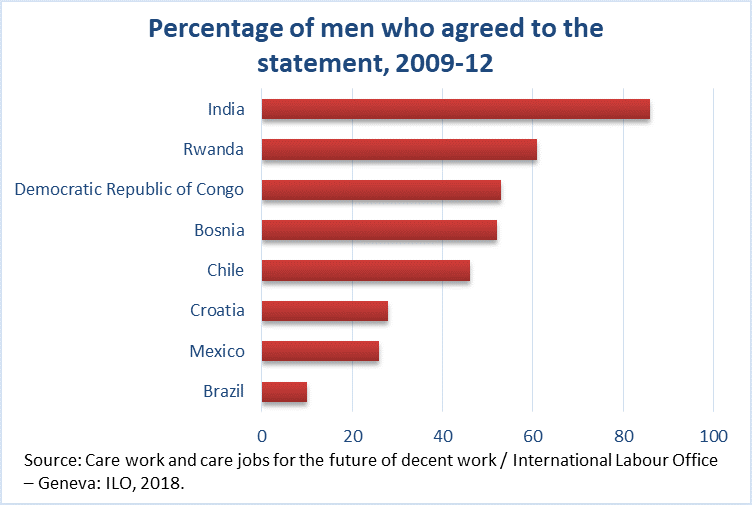
In yet another study conducted in 2009-12 for the International Men and Gender Equality survey, where over 10,000 men aged 18-59 who mainly living in urban settings in eight low and middle-income countries were surveyed. In the survey, men were asked whether they agree to the statement “Changing diapers, giving kids a bath and feeding kids are mothers’ responsibility.” In the figure above it can be seen that while only 10% of men in Brazil agreed to this statement, over 86% of men surveyed in India agreed at the same time. This survey is evidence to show how gendered roles influence occupations and family structure in India. Most women from a young age grow up in a society which teaches them there are certain exclusive roles which the women play in the society and any woman who refuses to abide by them is morally insulted and excluded.
The figure above shows the female labour force participation rates across the states in the country obtained from State of Working Indian 2018 report. It was found from the report that, the southern and north-eastern states performed better than the rest of the country. According to the ILO report, India ranks 120 among 131 countries in female labour force participation rates and rates of gender-based violence remain unacceptably high.
At 17% of GDP, the economic contribution of Indian women is less than half the global average. Annette Dixon, South Asia vice president of The World Bank said that “India could boost its growth by 1.5 percentage points to 9 per cent per year if around 50% of women could join the workforce. Research shows that even women that have completed skills programs and get jobs but tend to drop out in response to family pressures. Changing social norms around marriage, work and household duties will have to be part of the agenda.”
Feminists and especially Marxist feminists state that unpaid care work done by women, the oppression and stereotyping done which results in the women not doing any paid work but staying at home reproducing the labour, in both the biological and social sense where the man is able to go regularly to work because the woman is constantly caring for him. The major solution suggested to this problem is that women also work as wage labour, when this happens, the housework is not shared by the husband and wife but rather another woman is held responsible to do the same job with the same conditions of respect, oppression and degradation with just one minor change in the reward where that woman is paid a substantial wage. There has been an improvement in the female economic participation in India, according to 1991 census female WRP for urban areas was 7.18 which rose to 8.31 in 2001 and finally to 9.91 in 2011. Regardless of the above, the average time spent by a man in India doing housework is only 19 minutes a day while the women spend above five hours according to the Organization for Economic Co-operation and Development (2014).
Distribution of households by the number of Wage/Salaried Persons. This a depiction of the extent of the informal market. Source: Labour Bureau EUS-2015
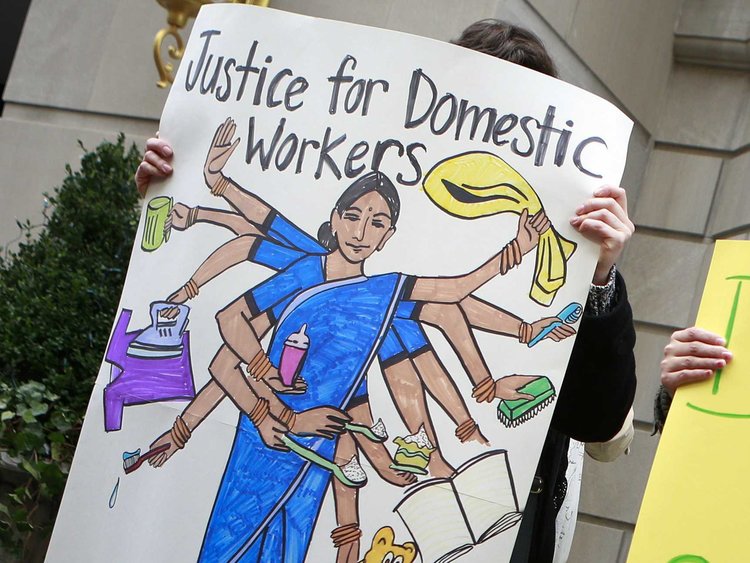
In India, domestic help is one of the jobs that are part of the informal sector. The informal sector is the part of the labour force in which the labour is unorganized with no regular work, no job security, no health security and risky workplaces. According to the National Commission of Self-employed Women, almost 94% of working women in India work in the informal sector.
Laxmi is the househelp in this house. She is in her early 30’s, she is a mother of 6 children. Her husband does small time daily wage jobs like cleaning people’s cars. She lives in the slum on the other end of the city near the river. She has to walk for 10 mins and wait another 20 minutes to use the public toilet and she gets water twice in a week. Her responsibilities in the Sharma house are to clean the house, do the preparatory (supplementary) work for cooking and to take care of the children of the house. She works in 4 houses, she starts at 9 in the morning and goes back home at 7 in the night every day of the week. She earns 800 rupees per month per house. Even though she is upset that she has 3 daughters, they are the ones who handle the house while she is away. Her eldest son works on a construction site and the other two sons go to school.
She cleans every other place in the house except for the Pooja room because she is not allowed to go there, this is mainly because she is from a lower caste. She is allocated the utility space behind the kitchen where the washing machine is kept and the vessels are washed. She eats and rests in that space when she is done with her work. she has separate vessels allocation. She can only use the common bathroom that is on the terrace of the apartment meant to be used by all the domestic help. She is frowned upon every time she takes the lift.
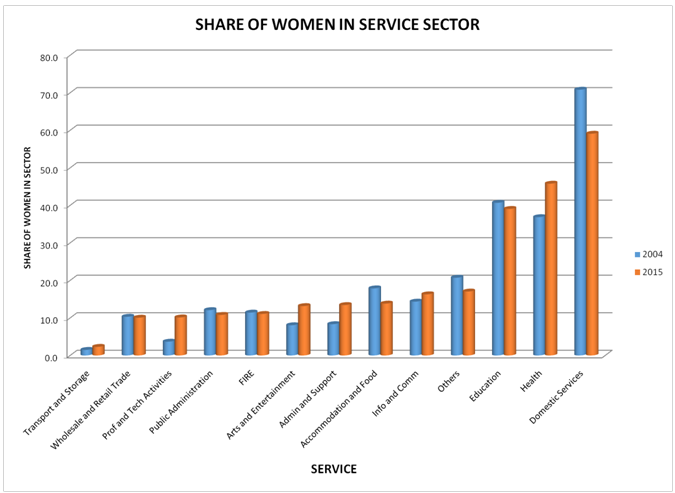
If you see most women have been employed in jobs related to care and their general domestic work. Source: State of Working India Report.
References:
Kumar, P. (2015). Women in unorganised sector-a case study of maid servants in Ghaziabad city. Journal of Commerce and Trade, 10(1), 66-73.
Basole, A. (2018). State of Working India 2018.Bengaluru: Azim Premji University.
EMPLOYMENT, M. O. Reporton the Fifth Annual Employment – Unemployment Survey (2015 – 1 6 ) Vol. 1.Chandigarh: GOVERNMENT OF INDIA.
Priya, the girl child of the family, being 20 years old, is doing her BA degree in literature. Family expectations from her revolves around getting married and not needing to do much with her career except maybe become a part-time teacher till she gives birth. Being a typical middle-class girl, her world inside and outside the house is interestingly comparable. Inside the four walls, she has grown up to see that her mother and grandmother perform the household chores (cooking, cleaning, appointing household help and others). She has been influenced into learning those chores as important characteristics she needs to acquire if she wants a happily married life. Outside these walls, she has to be careful about the kind of clothes she wears and has to come back before her curfew (before it is dark outside).
PRE-MARRIAGE NORMS
Sexual division of labor is a normative behavior which is a characteristic children, especially a girl child, are grown up with and termed as a fact of life. The kind of education which the girl child gets depends on the future expectations from her. In the graph below, it is shown that the least gender earnings gap is at Secondary level education (0.63%). This can be used to conclude the fact that the female gender is stigmatized into believing that their earnings are not as important as her husband. This results in the women not being sent to technical degree colleges which could result in a high paying job. Even if women have a master’s degree, the earnings gap is massive (0.88%). Women continue to be heavily under-represented among senior officers, legislators and managers (State of Working India, pg. 121) as they are considered to be ‘better-suited’ for homemaking and other unpaid labor.
POST-MARRIAGE NORMS
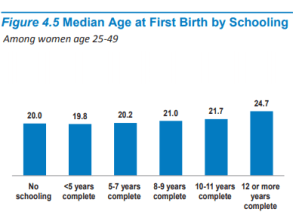
Reproduction of labor is a consequence of biological reproduction, which is largely effected by empowerment level of the girl child. Pregnancy and education are interlinked concepts in the Indian context. The constant family pressures on a girl to get married and have children is a normative behavior in the country. The age of the female at which she gives birth to her first child is shockingly early, especially when it comes to women who have completed less than 5 years of schooling (19.8 years) (NFHS 2015-16, pg. 82, figure 4.5). There are various caste and religious aspects also present in this interplay, but the interesting fact is that the amount of education has a positive relationship with the age at which a woman gives birth to her first child.
Nihal Sharma, the priced male child of the family, is in 10th grade looking forward to a professional career as most boys that age. He will mostly pursue a career in the IT department as he will have to provide for a family. He has grown up watching Bollywood movies which perpetuate patriarchy and rape culture. He thinks of women as the weaker sex. His family, time and again, have told him that he would inherit the family properties after his sister’s dowry has been paid. This also makes him expect dowry from his bride.
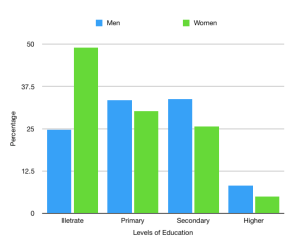
There continues to be a gender gap in education. This gap can be measured by looking at the gross number of girls enrolled in schools. Most poor children are sent to preschool and primary school as the government provides them with a meal. Despite this, girls primary school enrolment rate is only 30.43%. More women than men are left illiterate. The higher the level of education the more likely women drop out. By high school, only 1/6 girls who enrolled and 1/20 of all girls enrolled in high school. Once girls get their periods, they are expected to learn the household chores and prepare to get married. These are the expectations of most girls. They arise from ideas of what a girl should be like and become beliefs and actions that society implements. These are intern embodied by the educational system which perpetuates them and sees to it that women are within the given boundaries. The boundaries happen to be minimal or no education and a marriage.
So Nihal, being the boy, knows that he will get a better education. He while he aspires for a good college, his sister’s dreams would have to be of a good marriage even if she gets a higher education.
There is a gender segregation in the kind of work women do and which position they hold. Some jobs are seen as feminine and those are the jobs women are expected to do even if they work. Did the idea of women rub on to their preferred jobs or were occupations segregated and women were given the powerless ones to keep them powerless? In India, only 7% of managerial positions are held by women! Women are mostly found doing the assistant work to help others, mostly men, in their job to lower the production costs as woman’s work is worth lesser than a man’s. They hold 28% of all the jobs in technical and associate professionals. Though they are out of their house doing productive labor, they are still doing the care and supportive jobs which help men. Like educational institutes, ideas and beliefs of a woman are a part of the employers and employing institutes.
Nihal expects to be placed well when he finishes his studies. As the boss or under an experienced man. If his boss is a woman, it’s abnormal and insulting. Despite his sister’s education, she will not be expected to earn for the family or even if she does, nothing would be expected of her professionally.
Source: Figure 5.1, State of Working India, 2018, Azim Premji University.





 Reproduction of labor is a consequence of biological reproduction, which is largely effected by empowerment level of the girl child. Pregnancy and education are interlinked concepts in the Indian context. The constant family pressures on a girl to get married and have children is a normative behavior in the country. The age of the female at which she gives birth to her first child is shockingly early, especially when it comes to women who have completed less than 5 years of schooling (19.8 years) (NFHS 2015-16, pg. 82, figure 4.5). There are various caste and religious aspects also present in this interplay, but the interesting fact is that the amount of education has a positive relationship with the age at which a woman gives birth to her first child.



 The Average Indian Household