Priya, the girl child of the family, being 20 years old, is doing her BA degree in literature. Family expectations from her revolves around getting married and not needing to do much with her career except maybe become a part-time teacher till she gives birth. Being a typical middle-class girl, her world inside and outside the house is interestingly comparable. Inside the four walls, she has grown up to see that her mother and grandmother perform the household chores (cooking, cleaning, appointing household help and others). She has been influenced into learning those chores as important characteristics she needs to acquire if she wants a happily married life. Outside these walls, she has to be careful about the kind of clothes she wears and has to come back before her curfew (before it is dark outside).
PRE-MARRIAGE NORMS
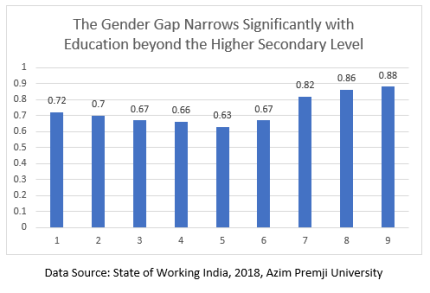
Sexual division of labor is a normative behavior which is a characteristic children, especially a girl child, are grown up with and termed as a fact of life. The kind of education which the girl child gets depends on the future expectations from her. In the graph below, it is shown that the least gender earnings gap is at Secondary level education (0.63%). This can be used to conclude the fact that the female gender is stigmatized into believing that their earnings are not as important as her husband. This results in the women not being sent to technical degree colleges which could result in a high paying job. Even if women have a master’s degree, the earnings gap is massive (0.88%). Women continue to be heavily under-represented among senior officers, legislators and managers (State of Working India, pg. 121) as they are considered to be ‘better-suited’ for homemaking and other unpaid labor.
POST-MARRIAGE NORMS
 Reproduction of labor is a consequence of biological reproduction, which is largely effected by empowerment level of the girl child. Pregnancy and education are interlinked concepts in the Indian context. The constant family pressures on a girl to get married and have children is a normative behavior in the country. The age of the female at which she gives birth to her first child is shockingly early, especially when it comes to women who have completed less than 5 years of schooling (19.8 years) (NFHS 2015-16, pg. 82, figure 4.5). There are various caste and religious aspects also present in this interplay, but the interesting fact is that the amount of education has a positive relationship with the age at which a woman gives birth to her first child.

Source: Alex Distasi and Nomi Kane, College Humor

 The Average Indian Household